




An Executive Briefing on Funding Organizational Capacity
Insights from The Bridgespan Group, Elevate Prize Foundation, IFTIN Global, and Black Fox Global
Convened by NEID Global and Black Fox Global | October 13, 2026
Philanthropic capital routinely funds ambitious outcomes: growth, scale, innovation, and systems change. But how consistently do we fund the organizational capabilities required to achieve those outcomes—and sustain them?
That question brought together four perspectives for Capacity-Building Funding: When Engaging Strategic Partners Is the Highest-Impact Grant You Can Make. The discussion featured:
- Kashyap Shah | The Bridgespan Group — The Sector-Wide Perspective: Why organizational capacity remains chronically underfunded, and what needs to change.
- Esther Wang | Elevate Prize Foundation — The Funder’s Perspective: How thoughtful funders invest beyond programs, responding to what organizational leaders actually need.
- Mohamed Ali Diini | IFTIN Global — The NGO Leader’s Perspective: What becomes possible when funders invest in the institution behind the mission.
- Natalie Rekstad | Black Fox Global — The Capacity-Building Practitioner’s Perspective: What 13+ years of continuous improvement have revealed about building capabilities that last.
Watch the full session ➤ here.
Together, these voices explored a fundamental shift in philanthropic thinking: From funding what organizations do to investing in what organizations become capable of doing.
This Executive Briefing distills the conversation into practical insights for foundations, individual philanthropists, philanthropic networks, and the nonprofit leaders working alongside them.
➤ If You Read Nothing Else, Read This:
- “Capacity building is always important, but rarely urgent.” Its benefits may not be visible within a conventional grant cycle, making it easy to postpone. Yet the consequences of underinvestment compound over time. (Kashyap Shah)
- Fund organizations, not only projects. A mission cannot scale without the strategy, capital, talent, systems, and leadership needed to deliver it. (Kashyap Shah)
- Diagnose before prescribing. Fundraising challenges may be symptoms of deeper constraints, including strategic positioning, leadership bandwidth, or organizational infrastructure. (Kashyap Shah and Natalie Rekstad)
- Ask leaders what is actually keeping them up at night. Then give them meaningful agency to determine which support would make the greatest difference. (Esther Wang)
- Unrestricted capital and targeted capacity building are complementary. Flexible funding creates room to operate; specialized expertise can help organizations build capabilities they could not otherwise access. (Esther Wang)
- The seemingly mundane investments can be transformational. Financial management, monitoring and evaluation, organizational audits, and internal systems can open doors to future funding and better program design. (Mohamed Ali Diini)
- Invest in the whole leader, not just the organization. Storytelling, visibility, strategic confidence, and leadership support can transform an organization’s ability to mobilize resources and advocate for its mission. (Esther Wang and Mohamed Ali Diini)
- Execution and capability transfer must go together. A strategy that sits on a shelf is not transformation. Neither is indefinite outside execution that leaves an organization no stronger. (Natalie Rekstad)
- Institutional capacity is an investment, not simply overhead. Connect capacity-building expenditures to stronger outcomes, greater resilience, and longer-term returns. (Kashyap Shah and Mohamed Ali Diini)
- Judge success by what remains. The critical question is what an organization can accomplish independently that it could not accomplish before. (Natalie Rekstad)
To Begin: What Funders Told Us | Insights from Our Participants
We opened the session with a poll: When a grantee you believe in is struggling to grow or sustain its impact, what is your first instinct as a funder?
Nearly half of respondents (48%) chose to look more closely at what was actually constraining the organization. Another 20% prioritized investing in organizational capacity, while 12% favored more flexible funding and 6% focused on strengthening fundraising and revenue.
The results reveal a strong instinct among participating funders to diagnose organizational needs before prescribing solutions, a theme echoed throughout the conversation. That raises the central question: Once funders identify a capacity gap, how do they invest in addressing it effectively?
Part I | The Sector-Wide Perspective
Kashyap Shah, Partner & Head of the Bridgespan Nonprofit Development Program (Asia and Africa), The Bridgespan Group
Why Capacity Building Remains Important, but Rarely Urgent
Kashyap highlighted a persistent paradox: funders recognize the importance of organizational capacity, yet often prioritize immediate program needs over long-term institutional strength.
Four structural challenges help explain why:
- Invisible infrastructure: Like a building’s foundation, organizational capacity is often overlooked until weaknesses become apparent.
- Mismatched timelines: Grant cycles favor near-term results, while institutional strengthening takes years.
- Diffused responsibility: Funders support individual programs, often assuming someone else will invest in the organization itself.
- Reluctance to reveal vulnerabilities: NGO leaders may hesitate to disclose organizational weaknesses for fear of jeopardizing funding.
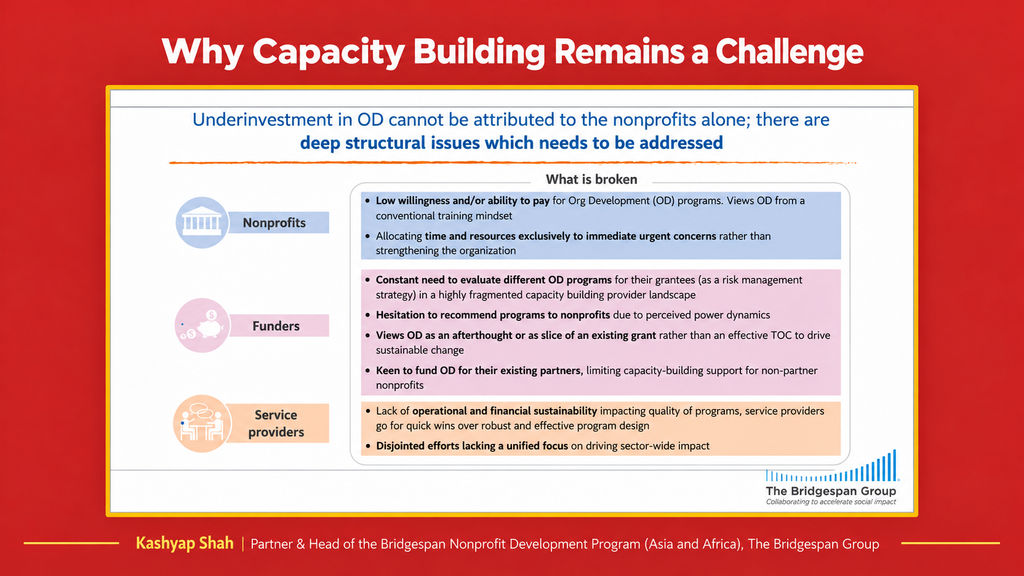
Kashyap also described the Strategy–Capital–Talent Trap: without clear strategy, organizations struggle to attract capital; without capital, they struggle to retain talent; and without talent, they struggle to execute strategy. What appears to be a fundraising problem may be a deeper organizational constraint.
Importantly, responsibility is shared across the ecosystem. Funders, NGOs, and capacity-building providers must all rethink how they approach institutional development. Training alone is not necessarily transformation.
The takeaway for funders: Treat organizational capacity as a strategic investment in mission success—not discretionary overhead.
Part II | The Funder’s Perspective
Esther Wang | Executive Advisor, Organizational Strategy, Elevate Prize Foundation
Beyond the Grant: Investing in the Leaders and Institutions Behind the Mission
Esther shared how Elevate Prize Foundation combines unrestricted grants with dedicated capacity-building investments, recognizing that even exceptional social-impact leaders need strong organizations and specialized expertise to sustain their missions.
Three principles guide Elevate’s approach:
- Fund capacity separately: Elevate maintains a dedicated fund for expert support—rather than requiring Prize winners to divert program funding toward organizational development.
- Listen before prescribing: Leaders identify their priorities, whether fundraising, governance, communications, or leadership development. Support is tailored and voluntary, preserving grantee agency.
- Build a muscle, not a crutch: Effective investments leave lasting skills, stronger systems, greater visibility, and capabilities that continue delivering value after external support ends.
Esther also emphasized a critical consideration: leadership readiness and bandwidth. Even well-funded, expertly designed support can fall short if an organization’s leaders lack the time or capacity to engage meaningfully.
The takeaway for funders: Pair flexible capital with tailored expertise. Let NGO leaders help determine what they need, and invest in capabilities that will strengthen their organizations long after the engagement ends.
Part III | The NGO Leader’s Perspective
Mohamed Ali Diini | Founder & Director, IFTIN Global
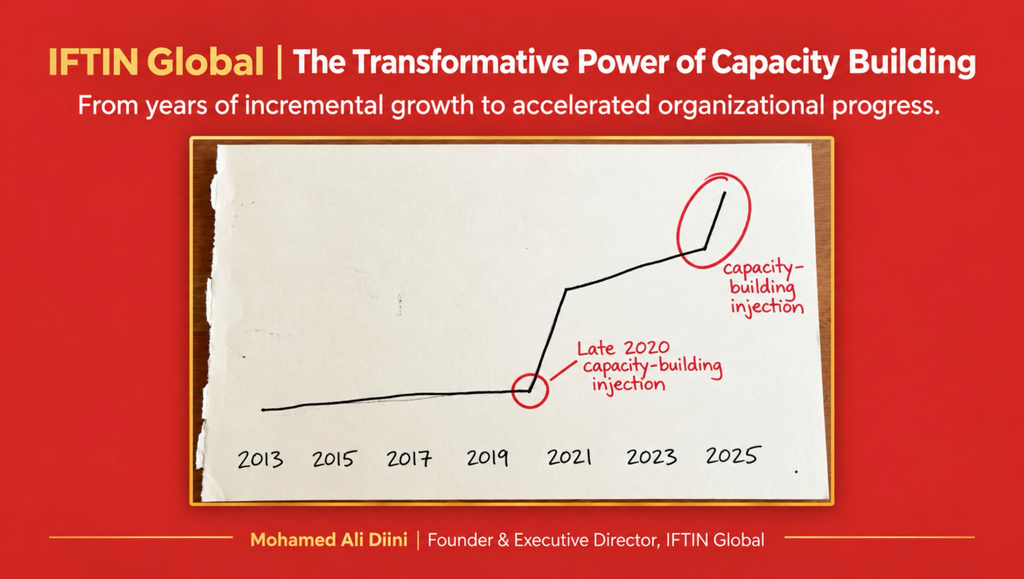
The Hockey-Stick Effect: How Capacity Building Unlocks Exponential Growth
Mohamed illustrated the transformative potential of capacity building through IFTIN Global’s journey in Somalia—from years of incremental growth to significant organizational acceleration following targeted investments.
Three powerful lessons emerged:
- Invest in the infrastructure behind the mission: Following capacity-building support from the Netherlands’ Ministry of Foreign Affairs in 2020, IFTIN strengthened its financial management, monitoring and evaluation, and internal systems. Better data even revealed how trauma-related mental health challenges were affecting youth employment outcomes, enabling more effective program design.
- Strengthen the leader to unlock funding: Through McNulty Foundation-supported strategic advisory with Black Fox Global, Mohamed strengthened his storytelling, strategic positioning, and funder engagement. He estimated that a recent capacity-building investment helped generate approximately $10 in subsequent funding for every $1 invested over 18 months—a compelling illustration of potential returns, rather than a universal benchmark.
- Build institutions that outlast donor funding: IFTIN helped strengthen a coalition of Somali-led organizations with the systems to mobilize and manage resources directly. After major donors exited, coalition members mobilized approximately $1 million from Somalia’s private sector, demonstrating the enduring value of locally owned institutional capacity.
As Mohamed explored in his Alliance Magazine article, The Architecture of Inheritance: What the Post-Aid World Can Learn from Apartheid South Africa, financing development is not the same as building institutions capable of sustaining it.
The takeaway for funders: Invest beyond programs: in the leadership, systems, and institutional capabilities that enable locally led organizations to attract resources, adapt, and thrive long after donor funding ends.
Part IV | The Capacity-Building Practitioner’s Perspective
Natalie Rekstad, Founder & CEO, Black Fox Global
Key Lessons from 13+ Years of Capacity-Building Work
Across 13+ years of working with mission-driven organizations spanning all 17 Sustainable Development Goals, Black Fox Global has seen remarkable successes in strengthening fundraising capabilities, expanding funder relationships, and mobilizing capital. Equally important have been the lessons from engagements that fell short—driving continuous refinement of our approach.
Four principles have emerged:
1. Diagnose Before Prescribing
The presenting problem isn’t always the underlying constraint. An organization seeking more funding may actually need stronger positioning, systems, leadership capacity, or funder relationships. Ask: Is this a capital constraint, a capability constraint, or both?
2. Timing and Leadership Readiness Matter
Even exceptional support can become a burden if leadership lacks the readiness, commitment, or bandwidth to engage. The right intervention at the wrong moment may deliver little lasting value.
3. Execution and Capability Transfer Must Go Together
Strategy alone is insufficient. Effective engagements combine practical fundraising execution with stronger internal systems, skills, and leadership capabilities. External expertise should strengthen the organization—not create dependency.
4. Judge Success by What Remains
Look beyond deliverables to lasting institutional strength: more effective fundraising systems, deeper funder relationships, greater financial resilience, and stronger leadership. One Black Fox Global Foundation Alliance, for example, helps grantees transition from foundation funding by developing new funder pipelines and relationships.
The takeaway for funders: Invest in capabilities that endure. A meaningful measure of success is what an organization can accomplish independently that it couldn’t accomplish before.
Part V | A Practical Tool for Funders
➤ The Black Fox Global ‘Capacity Investment Readiness Test’
How can funders translate these lessons into more thoughtful investment decisions?
Black Fox Global introduced a Capacity Investment Readiness Test. The framework invites funders to assess five dimensions before investing.
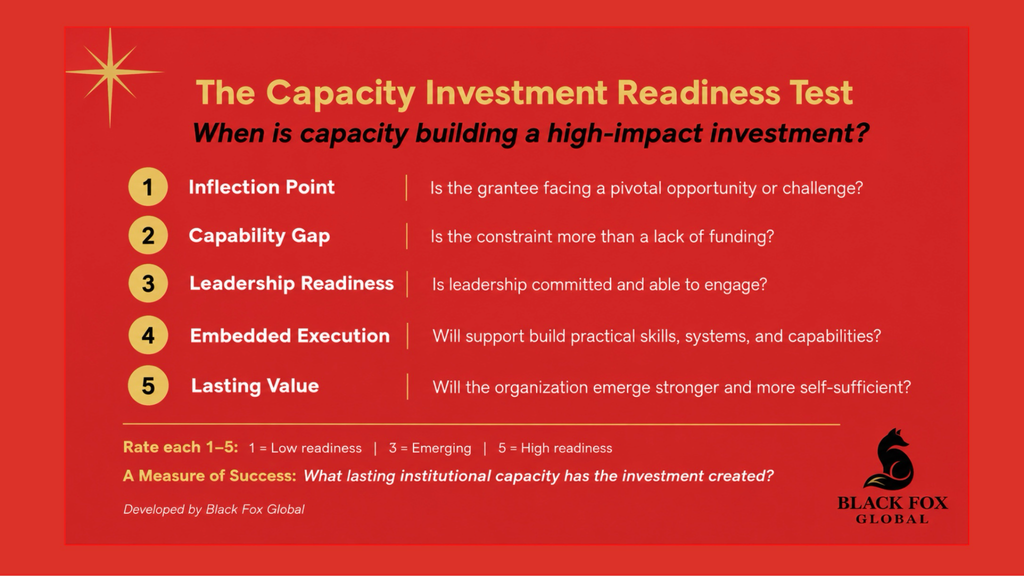
Each dimension can be rated from one to five to stimulate discussion and identify areas requiring further diagnosis. Importantly, this is not a rigid pass-or-fail test. A lower readiness score does not necessarily mean an organization should receive less funding. It may mean that unrestricted support, a preparatory investment, or a different form of assistance would be more valuable at that moment.
The purpose is to improve the quality of the investment decision, not create another hurdle for nonprofit leaders.
Part VI | Key Takeaways from the Audience Q&A
The participants raised questions about recognizing capacity gaps, ensuring lasting value, and making the case for investment.
1. When Is More Funding Not the Answer?
Kashyap identified warning signs: leadership bottlenecks, high staff turnover, weak data systems, difficulty deploying existing funding, or expansion that compromises quality. These may signal organizational constraints that additional capital alone cannot resolve.
2. How Do We Know Capacity Building Is Working?
Esther emphasized looking beyond completed deliverables to enduring organizational improvements. Stronger systems, capabilities, and leadership matter—even when their full value takes years to emerge.
3. What Can Derail Even a Well-Funded Engagement?
Leadership bandwidth and readiness. Esther noted that overwhelmed NGO leaders may struggle to engage with expert support, however valuable. Funding and expertise must be matched with organizational capacity to participate.
4. How Do We Make the Investment Case?
Kashyap encouraged framing capacity building as a strategic investment, not merely a moral obligation. Demonstrate how stronger systems, fundraising, leadership, and data capabilities improve outcomes and financial resilience. Mohamed’s reported fundraising returns illustrate the potential for measurable results.
The overarching lesson: Diagnose organizational constraints, invest with leadership readiness in mind, and measure success by the lasting capabilities created, not simply the services delivered.
This is an open-source resource developed by Black Fox Global following our October 13, 2026, conversation co-hosted with NEID Global.
➤ A Closing Perspective | Investing in What Lasts
NEID Global and Black Fox Global share a commitment to strengthening the organizations and leaders behind lasting impact. Together, NEID’s philanthropic network and Black Fox Global’s capacity-building expertise connect funder perspectives with practical solutions.
Effective investments begin with understanding an organization’s needs – whether flexible funding, specialized expertise, stronger systems, or hands-on support.
With deep thanks to Kashyap Shah, Esther Wang, and Mohamed Ali Diini for sharing their insights, and all who joined the conversation. We hope this Executive Briefing inspires more strategic investments in organizational capacity and continued dialogue across the philanthropic community.
➤ About the Convening Organizations
NEID Global (Network of Engaged International Donors) is a global philanthropy network connecting donors, foundations, and philanthropic advisors committed to creating meaningful, lasting impact. Founded in 2008, NEID Global brings together more than 415 members supporting initiatives across 91 countries. Through peer learning, expert-led conversations, giving circles, and collaborative partnerships, NEID Global helps philanthropists make more informed, strategic, and equitable funding decisions.
Black Fox Global is a global fundraising strategy and execution consultancy dedicated to helping mission-driven organizations mobilize the resources needed to advance their solutions. Working with nonprofit leaders and funders, Black Fox Global provides strategic advisory, hands-on fundraising execution, and capacity-building programs designed to strengthen institutional capabilities, deepen funder relationships, and build lasting financial resilience.
Continue the Conversation & Explore Resources
NEID Global
Black Fox Global
- Explore Black Fox Global’s Foundation Alliances | Capacity-building partnerships for foundations and grantee portfolios.
- Connect with Black Fox Global | Explore opportunities for strategic fundraising and capacity-building support.
- Subscribe to the Black Fox Brief | News, funding trends, emerging opportunities, and practical insights for the global social-impact sector.
- Explore Black Fox Global’s Open Source resources | Freely available knowledge and tools to strengthen the sector.
This Executive Briefing was developed following the October 13, 2026, conversation co-hosted by NEID Global and Black Fox Global, reflecting a shared commitment to advancing thoughtful philanthropy and lasting institutional impact.